



You aren’t born with obsessive-compulsive disorder (OCD), but research shows that genetics and brain differences can make some people more likely to develop the condition. Twin studies suggest that 45-65% of the risk factor for OCD is inherited, meaning family history can increase the likelihood. However, having a genetic predisposition doesn’t guarantee that you will develop OCD—it usually requires environmental or life events, such as stress or trauma, to trigger symptoms.
Let’s take a look at when OCD typically starts and the effective treatments that can help.
At what age does OCD usually start?
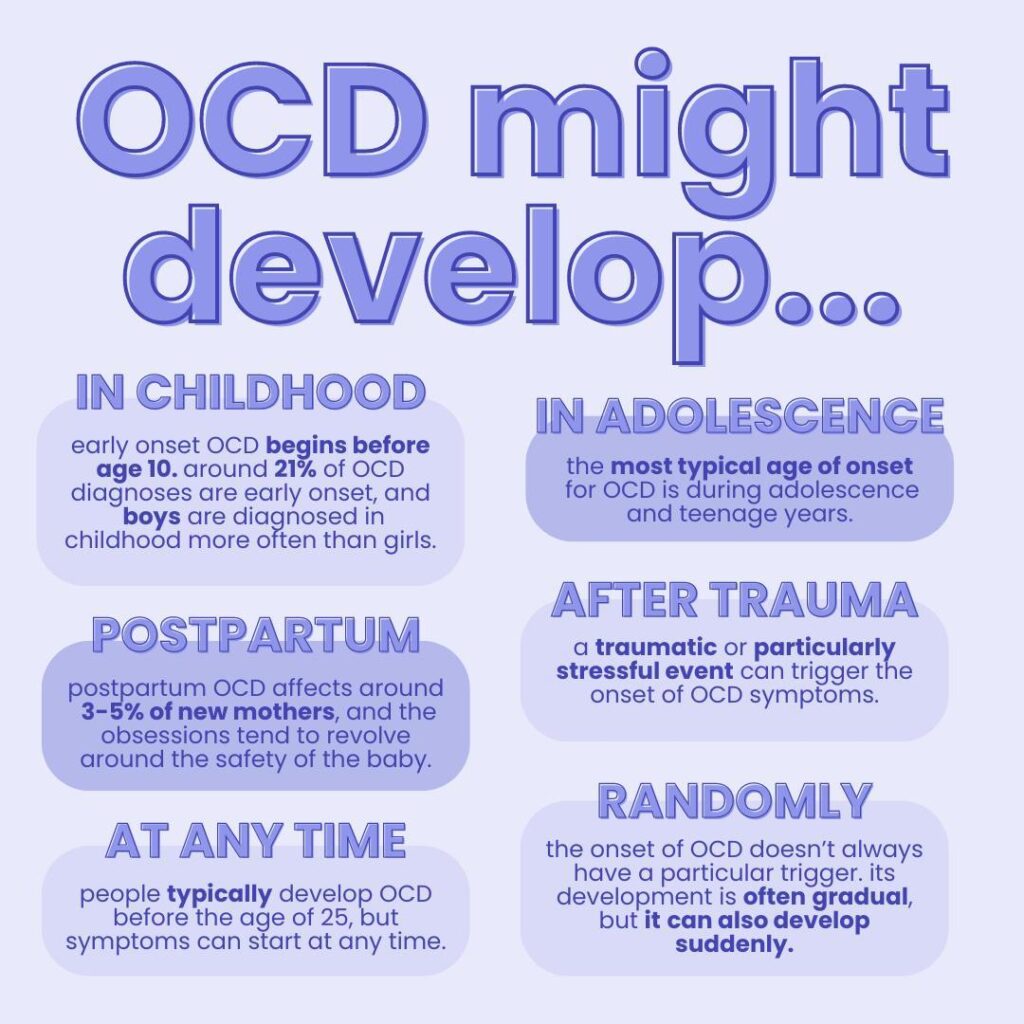
OCD often begins in childhood, adolescence, or early adulthood. While the average age of onset is around 19, symptoms can appear as early as 8 years old. There are typical age ranges when OCD first appears:
- Childhood-onset: Ages 8-12
- Early adult-onset: Late teens to early 20s
Once symptoms appear, they tend to persist if left untreated. However, early recognition and therapy can help manage symptoms and prevent OCD from becoming more severe over time.
Can you develop OCD later in life?
Yes, OCD can develop in adulthood, even in people who have never experienced symptoms before. Although less common, late-onset OCD can appear in a person’s 30s, 40s, or later. Potential triggers can include stressful life events, hormonal changes, or co-occurring mental health conditions. In rare cases, neurological changes like head trauma or neurodegenerative conditions may contribute to the onset of OCD.
Adults with late-onset OCD often experience similar obsessions and compulsions as those seen in younger individuals, though their symptoms may focus more on concerns about health, morality, or family-related fears.
What causes OCD to develop?
OCD is thought to develop as a result of a combination of factors, including:
- Genetics: Family history plays a role in increasing the risk of developing OCD, suggesting a genetic predisposition.
- Brain differences: Research shows changes in brain circuits, particularly those involved in decision-making and fear regulation, may contribute to OCD.
- Environment: Stressful or traumatic events, such as abuse, major life transitions, or significant loss, can trigger OCD symptoms.
- Medical factors: In some cases, conditions such as PANDAS (Pediatric Autoimmune Neuropsychiatric Disorders Associated with Streptococcal infections) may trigger OCD in children.
While no single factor “causes” OCD, the disorder often results from a complex interaction of biological factors and life experiences.
Does OCD go away on its own?
OCD rarely goes away without treatment, and its symptoms often worsen during periods of stress. Delaying treatment can make recovery more challenging.
The most effective treatment for OCD is exposure and response prevention (ERP) therapy. ERP is a specialized form of cognitive behavioral therapy (CBT) tailored to help individuals face their fears without engaging in compulsive behaviors. General CBT, if not tailored for OCD, can sometimes be unhelpful or even worsen symptoms. Studies show that ERP therapy is highly effective, with 80% of people with OCD experiencing a significant reduction in their symptoms.
Other approaches that may help include:
- Medication (typically SSRIs)
- Mindfulness-based strategies
- Acceptance and commitment therapy (ACT)
These are typically done in combination with ERP therapy, depending on the individual’s needs.
Severe or treatment-resistant OCD may benefit from the following therapies:
- Intensive outpatient programs (IOPs)
- Partial hospital programs (PHPs)
- Residential treatment centers (RTCs)
- Transcranial magnetic stimulation (TMS)
- Deep brain stimulation (DBS)
- Gamma knife radiosurgery (GKRS)

Find the right OCD therapist for you
All our therapists are licensed and trained in exposure and response prevention therapy (ERP), the gold standard treatment for OCD.
Bottom line
You are not born with OCD in the way you’re born with physical traits like a specific eye color, but genetics and brain biology can increase your likelihood of developing it. Symptoms usually begin in childhood, adolescence, or early adulthood, but OCD can also occur later in life, especially when triggered by stress or medical factors. No matter when it starts, OCD is treatable, and effective therapies are available at any age.
Key takeaways
- You are not born with OCD, but genetics and brain biology can increase your risk.
- OCD most often begins in childhood, adolescence, or early adulthood, with an average onset around age 19.
- While less common, OCD can also develop later in life, sometimes triggered by stress, trauma, or medical changes.
- OCD rarely goes away on its own, but evidence-based treatments like ERP therapy and medication can lead to major improvement.
- If you or someone you know is struggling with OCD symptoms, reaching out for professional help can make all the difference. Effective therapies, support groups, and treatments are available to guide you toward recovery.