



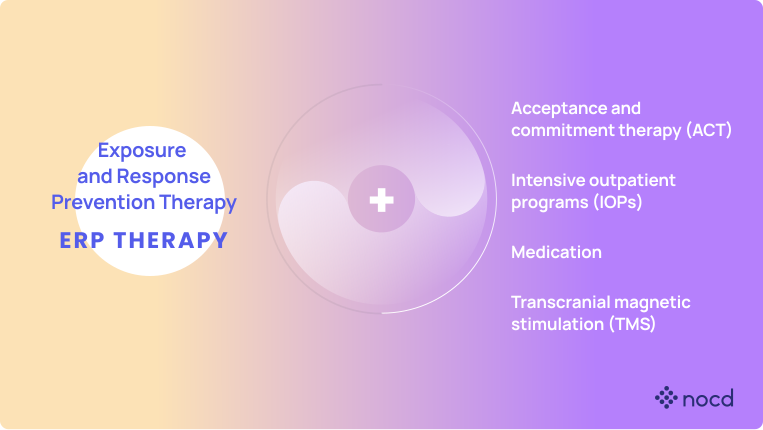
There are several effective treatments for obsessive-compulsive disorder (OCD), but they aren’t interchangeable. Some are used as first-line treatments, while others are considered when symptoms are more severe or haven’t improved enough with standard care.
What are the first-line treatments for OCD?
Exposure and response prevention (ERP) is the first-line psychological treatment for OCD. Medication, most commonly a selective serotonin reuptake inhibitor (SSRI), may also be used on its own or alongside ERP depending on your symptoms and treatment needs.
Therapy
ERP is a specialized form of cognitive behavioral therapy (CBT). During ERP, you gradually face situations, thoughts, images, feelings, sensations, or other triggers that cause distress while resisting the urge to perform compulsions for relief or to prevent a feared outcome.
The goal isn’t to prove that your fears won’t come true or make uncomfortable thoughts and feelings disappear. It’s to learn that you can experience uncertainty and distress without relying on compulsions. Over time, this helps break the cycle that keeps OCD going.
Other therapeutic approaches may be used alongside ERP. Acceptance and commitment therapy (ACT) can help you make room for uncomfortable thoughts and feelings while choosing actions based on what matters to you. Mindfulness strategies can help you notice thoughts and sensations without automatically reacting to them.
Medication
When medication is used to treat OCD, SSRIs are typically the first type prescribed. Fluoxetine, fluvoxamine, paroxetine, and sertraline are FDA-approved for treating OCD in adults, while other SSRIs may be prescribed off-label. Finding the right medication and dose may take time, and it can take several weeks to see the full benefits of an SSRI. Treatment response is often assessed over about 12 weeks.
A psychiatrist or other qualified prescriber can help determine whether medication makes sense for you, choose an appropriate medication, and monitor your response.
Can you use ERP and medication together?
Yes. ERP and SSRIs can be used separately or together. For people with more severe OCD, or when one treatment alone hasn’t helped enough, combining ERP with an SSRI may be recommended.
There isn’t one treatment combination that’s right for everyone with OCD. Some people do well with ERP alone, while others may benefit from medication alongside therapy—especially when symptoms are making it harder to engage fully in ERP.
April Kilduff, MA, LCPC, LMHC, LPC
What if first-line OCD treatment isn’t enough?
ERP and SSRIs are effective first-line treatments for OCD, and many people improve with one or both. But when symptoms don’t improve enough, treatment can be adjusted or intensified.
Medication changes
If one SSRI hasn’t provided enough relief, a prescriber may recommend trying a different SSRI or clomipramine, a tricyclic antidepressant that can also be effective for OCD.
Intensive treatment programs
An intensive outpatient program (IOP) may involve several hours of treatment on multiple days each week instead of a single weekly therapy session.
When outpatient care isn’t intensive enough, residential treatment provides structured OCD treatment throughout the day. These programs typically provide more frequent ERP along with additional support, such as group therapy, family involvement, and/or medication management.
Transcranial magnetic stimulation (TMS)
Transcranial magnetic stimulation (TMS) is a noninvasive, FDA-cleared treatment that uses magnetic fields to stimulate areas of the brain involved in OCD. TMS is generally considered later in the treatment process rather than as a first-line treatment. A clinician who specializes in OCD can help determine whether it makes sense based on the treatments you’ve already tried and the severity of your symptoms.
Specialized procedures
For people with severe, treatment-resistant OCD that has not improved after multiple evidence-based treatments, highly specialized procedures may be considered.
Deep brain stimulation (DBS) is a surgical treatment that uses implanted electrodes to stimulate specific areas of the brain.
Gamma Knife radiosurgery is an experimental procedure that uses precisely targeted radiation to create a small lesion in an area of the brain involved in OCD. Because it permanently alters brain tissue, it is considered only in highly select cases.

Find the right OCD therapist for you
All our therapists are licensed and trained in exposure and response prevention therapy (ERP), the gold standard treatment for OCD.
How is OCD treated in children and teens?
ERP is also a first-line treatment for children and teens with OCD, but treatment is adapted to the child’s age and developmental needs. Parents or caregivers are often involved so they can support ERP at home and learn how to respond without unintentionally reinforcing compulsions.
If ERP alone doesn’t help enough, medication may also be considered. SSRIs are the main medications used for children and teens with OCD and may be added to ongoing ERP, with careful monitoring by a qualified prescriber.
Bottom line
Most people with OCD start their treatment with ERP, medication, or both. If those approaches don’t provide enough relief, treatment can be adjusted or intensified, with more specialized options available for severe or treatment-resistant symptoms.