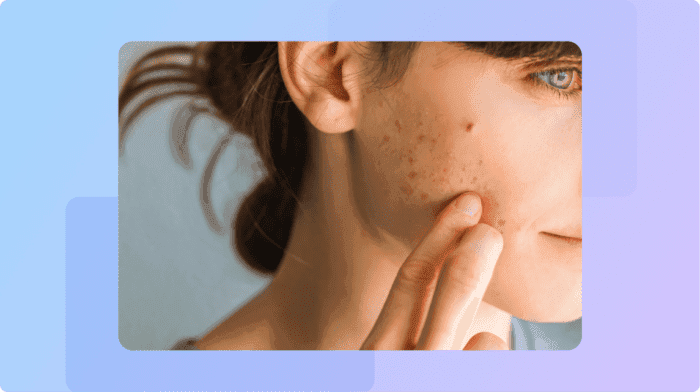


Have a “bad habit” you can’t seem to break?
Maybe you keep pulling your hair, picking at your skin, biting your nails, or chewing the inside of your cheek—even when it hurts, leaves marks, or makes you feel ashamed.
If you’ve tried to stop but keep finding yourself doing it again, it may be more than a habit.
What are body-focused repetitive behaviors?
Body-focused repetitive behaviors (BFRBs) are repeated behaviors like hair pulling, skin picking, nail biting, or cheek biting. They often develop between ages 11 and 15, but onset can happen at any age. Over time, behaviors like picking or pulling can also cause physical damage, including soreness, open wounds, scarring, infections, or hair loss.
BFRBs are more common than many people realize: research suggests that about 1 in 20 people have a BFRB.
BFRBs can be difficult to treat because they don’t always follow one clear pattern. They may happen in response to stress, anxiety, boredom, or intense focus. But they may feel automatic—it’s not uncommon for someone to suddenly notice they’ve spent a half hour picking at their skin or pulling their hair without ever realizing it.

Find the right OCD therapist for you
All our therapists are licensed and trained in exposure and response prevention therapy (ERP), the gold standard treatment for OCD.
Why can’t I just stop?
If you live with a BFRB, it can be easy to get stuck in questions like: “What’s wrong with me?” “Why do I keep doing this?” “Don’t I have any willpower?”
People feel like they should be able to stop. When they can’t, they feel defective.
Ruth Golomb, M.Ed., LCPC, Author of The Hair Pulling “Habit” and You.
But struggling to stop doesn’t mean you’re weak or not trying hard enough. BFRBs can provide brief relief, satisfy a physical urge, or happen so automatically that you don’t notice until afterward. As that pattern repeats, your brain learns to return to the behavior—making it difficult to change through willpower alone.
How do I know if I have a BFRB?
It can be hard to tell when something is “just a habit” and when it may be a BFRB. A few signs to look for include:
- It causes physical damage. You may have soreness, cuts, scabs, scars, infections, hair loss, or other lasting effects.
- It feels difficult to control. You may feel a strong urge to pick, pull, bite, or chew, even when part of you wants to stop.
- It happens automatically. You may not realize you’re doing it until you notice the damage, or until someone points it out.
- It brings up shame or secrecy. You may try to hide the behavior, cover the damage, or avoid situations where other people might notice.
You don’t need to relate to every sign on this list for a BFRB to be worth taking seriously. If picking, pulling, biting, or chewing is causing distress, physical damage, shame, or problems in your daily life, it may be worth looking into treatment.
How can I stop picking, pulling, biting, or chewing?
Putting a stop to a BFRB usually doesn’t mean finding one trick that makes the urge disappear. It means learning how the behavior works for you, then building new responses that make picking, pulling, biting, or chewing easier to interrupt over time.
BFRBs are treated with habit reversal training (HRT), which includes:
- Awareness training: monitoring when, where, and how the behavior happens, so you can better understand your patterns and triggers.
- Competing response training: practicing a different action when the urge shows up—something that makes picking, pulling, biting, or chewing harder to continue. Depending on the behavior, that might mean crossing your arms, sitting on your hands, using a fidget, chewing gum, wearing a barrier (like a glove), or keeping your hands occupied in another way.
Another CBT-based approach is the Comprehensive Behavioral Model (ComB). ComB takes a broader look at what causes the behavior, including sensory urges, emotions, thoughts, movements, and environments. This can help treatment feel more tailored, especially when a BFRB has more than one trigger or pattern.
Treatment may also involve addressing physical triggers or damage. If picking, pulling, biting, or chewing has caused wounds, infections, hair loss, scarring, or irritation, a dermatologist or other healthcare provider can help. For some people, treating acne, dry skin, or other sources of discomfort can also reduce triggers for the behavior.
Medication may be considered in some cases, especially when BFRBs occur alongside anxiety, depression, OCD, or another mental health condition. No medication is specifically approved to treat BFRBs, so medication is usually considered one part of a broader treatment plan—not a replacement for behavioral therapy.
Find the right OCD therapist for you
All our therapists are licensed and trained in exposure and response prevention therapy (ERP), the gold standard treatment for OCD.
Why choose NOCD for BFRB treatment?
While NOCD is best known for OCD, we’ve also treated thousands of members for BFRBs like hair pulling, skin picking, nail biting, and related behaviors.
BFRBs often overlap with OCD, anxiety, depression, and other conditions, but we don’t assume every member who comes to NOCD has OCD, or that every repetitive behavior should be treated like an OCD compulsion.
Our therapists receive extensive training in habit reversal training (HRT). They’re also trained in exposure and response prevention (ERP), so care can be tailored to what you’re actually experiencing—not forced into a one-size-fits-all model.
NOCD tracks BFRB outcomes using a validated assessment designed specifically for these behaviors, rather than an OCD scale. In internal outcomes data, members with follow-up assessments saw a 30% average reduction in BFRB symptoms, and many experienced meaningful improvement in about six weeks.
Bottom Line
BFRBs can look like “bad habits” from the outside, but they can be much harder to stop than that. If you keep picking, pulling, biting, or chewing even when it causes pain, damage, shame, or disruption in your life, you’re not weak or failing—you may need more support.
With the right treatment, BFRBs can become easier to understand, interrupt, and manage. A therapist trained in approaches like HRT can help you understand your patterns, build strategies that fit your life, and start interrupting the cycle with support.