

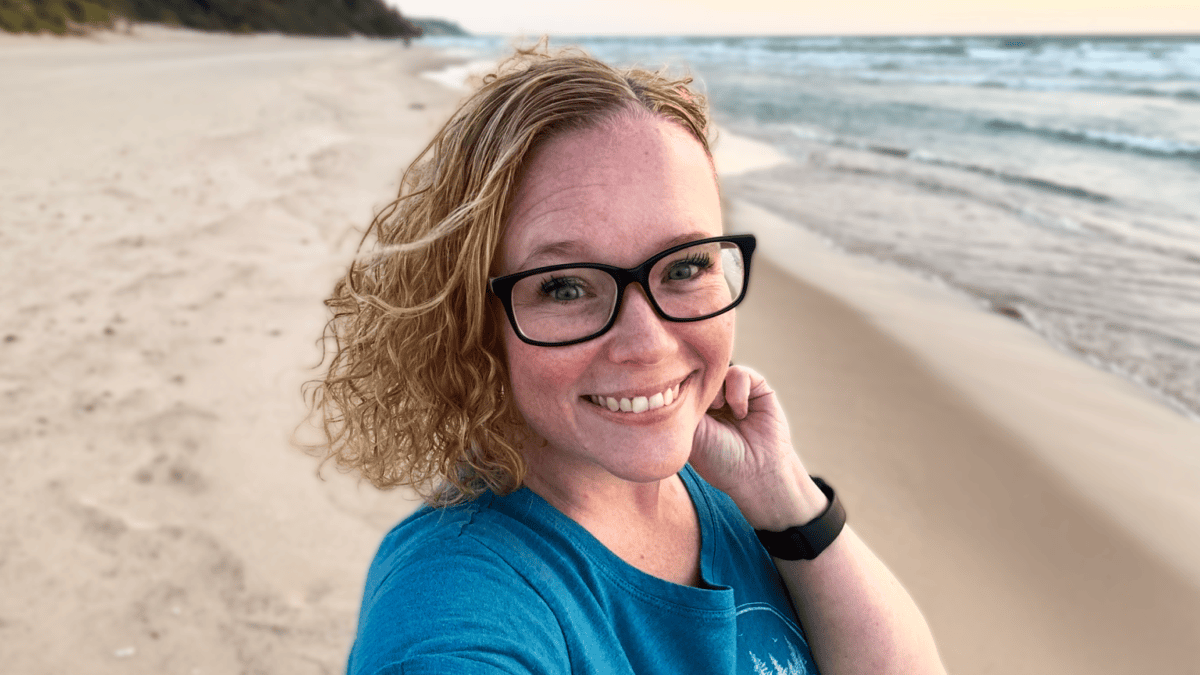
Meet Alicia Kaja, LISW the therapist who found specialized training at NOCD and brought what she learned back to her rural Michigan community.
Before Alicia specialized in OCD, she worked with someone she couldn’t figure out how to help.
She was a therapist in community mental health, and the person she was treating couldn’t stop staring at people despite not wanting to. Alicia knew something was happening, but she didn’t have the training to understand what.
“I was doing my best, but I wasn’t giving them what they needed,” she says.
So she started researching. That search led her to OCD and eventually to a video from Nathan Peterson. Her first reaction to the treatment she saw?
“I was like, I can’t do this, there’s no way.”
But the idea stayed with her, and Alicia wanted to know more. Living in rural northern Michigan, she says there were no therapists on her side of the state treating OCD at the time.
“I just knew I wanted to bring it to a community that didn’t have access,” she says.
In March 2023, she joined NOCD.
Learning what she hadn’t been taught
Alicia received little training in OCD or exposure response prevention (ERP) therapy in graduate school. What she remembers hearing about exposure therapy was essentially this: it works but clients wouldn’t do it because it was too difficult.
“They were like, exposure therapy is very effective, but nobody’s gonna do it,” she recalls. “So we’re just gonna move on.”
Her understanding of OCD was limited, too. At NOCD, she discovered how much more there was to learn.
“I was really surprised by how comprehensive the training was,” she says. “And I was surprised how many different subtypes there were.”
But the biggest surprise was seeing what happened when Members received specialized treatment.
“The biggest surprise was how effective it was,” says Alicia. “Being able to see people make significant gains in a short period of time compared to treating chronic depression and anxiety, it was a whole different world.”
Falling in love with the work
Alicia didn’t expect to fall in love with treating OCD.
She watched Members begin doing things they couldn’t do before.
“We actually see our members make progress,” she says. “That’s what really kind of made me fall in love with NOCD.”
NOCD also gave Alicia access to people she describes as leaders in the field, which is especially meaningful for someone from rural northern Michigan. She points to her experiences with Dr. Patrick McGrath, Taylor Newendorp and Tracie Zinman-Ibrahim as particularly important to her growth.
“Whenever my cup is getting dry, I join her consultation group just to remember why I do this,” she says of Ibrahim.
Moving beyond a misconception
There was one part of OCD treatment Alicia wasn’t sure she could do.
Before becoming a therapist, she spent seven years working in child welfare, including CPS, foster care, and foster home licensing. Her work included experience with victims and perpetrators of child sexual abuse.
So when she learned that treating OCD could mean working with Members experiencing pedophilia OCD, or POCD, she hesitated. “I wasn’t sure I could do that.”
At the time, Alicia didn’t understand that POCD involves unwanted, intrusive thoughts that people find deeply distressing, not desires they want to act on. These intrusive thoughts are ego-dystonic.
Then she began working with Members who had POCD.
“My first experience working with people with POCD, I suddenly realized, no, it’s not that at all,” she says. “These people are not a risk to anyone else. They’re so terrified by the very idea that it’s controlling their life.” Today, she says POCD can be one of her favorite subtypes to treat.
Alicia’s shift in perspective shows why specialized OCD training, and broader awareness of OCD, matter so much. It’s crucial to understand that intrusive thoughts go against a person’s values, so people who experience them can find the right care, and feel safe reaching out for help.
Bringing access home
Three years later, Alicia shared how access to OCD treatment in her community looks different.
“In a matter of three years, it went from there’s nobody in this community in this area to there are multiple providers that people can access,” she says.
At NOCD, she found a way to continue doing the work she loves remotely.
“To be able to do the work that I love with my limitations, it’s been great,” she says. “I can provide for my family because NOCD provides those benefits.”
Asked for one word to describe her experience at NOCD, Alicia doesn’t hesitate.
“Transformative.”
Looking to make an impact like Alicia? Explore therapist opportunities at NOCD.