



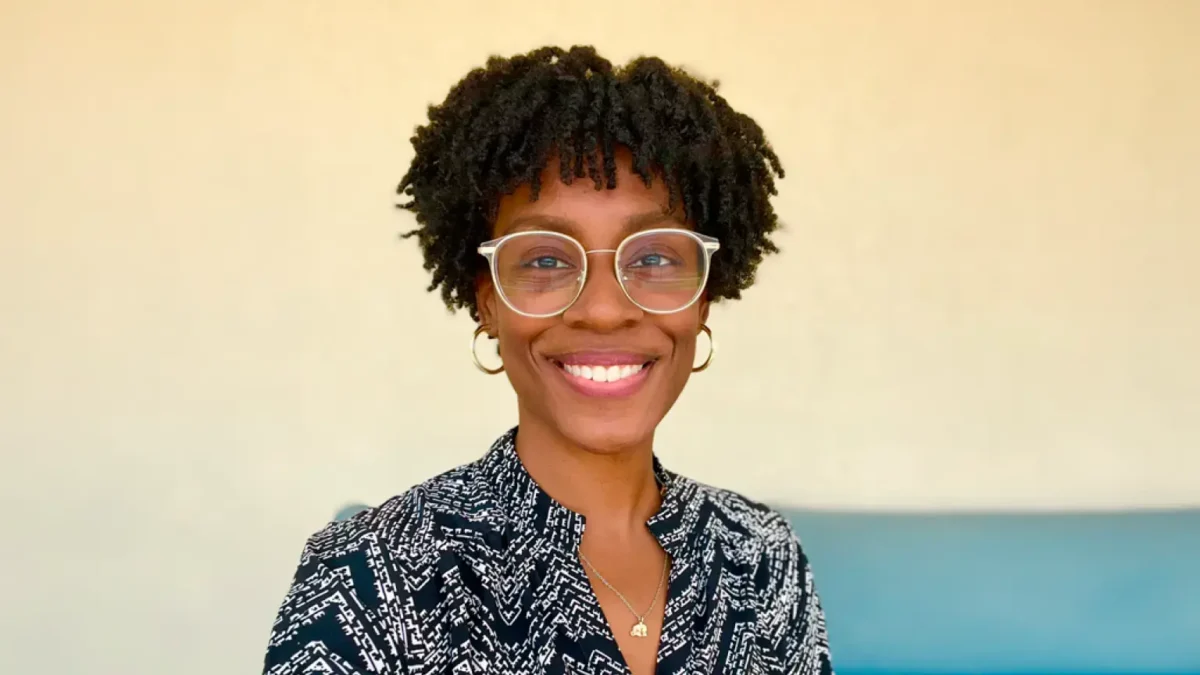
How Lisa Marie Porter, MA, LMHC almost didn’t apply to NOCD but is glad she did and found “the right fit”
Before joining NOCD, Lisa Marie Porter worked as an intake specialist at an inpatient psych hospital, assessing people in crisis to determine what level of care they needed. When that role ended, she began looking for her next opportunity and came across a job listing for NOCD.
She almost didn’t apply.
“I didn’t have experience working with obsessive-compulsive disorder (OCD) at all,” she says. “I was aware of what OCD was in a brief, very textbook version of OCD, but I didn’t have any experience working with the population. So I wasn’t sure that I was qualified enough to get the position looking at the job description on its own.”
What changed her mind wasn’t the job posting. It was her partner. “I was encouraged by my partner at the time to apply,” she says. “He was like, you never know what’s gonna happen.” NOCD’s listing mentioned that all therapists were trained, regardless of prior OCD experience, and that was enough to convince her to apply.
Training that resolved every doubt
Porter’s hesitation didn’t last long once she started.
“What surprised me was how robust the training and onboarding process was,” she says. “I had never been in a job where they spent that much time training you and really giving you all that you need to be equipped to treat that population. I was really blown away by how intentional they were in the training and how accessible and helpful the management and training team were. I’d never encountered that before in any kind of company.”
The content of the training surprised her too. She’d assumed that OCD mostly looked like contamination fears, the version of the condition that most people are familiar with. Instead, she learned just how many subtypes and themes of OCD there are. What struck her most was learning that exposure and response prevention (ERP) therapy worked no matter which one a Member was dealing with. “I was surprised that ERP was so effective no matter the subtype or theme,” she says, “that no matter what someone showed up with, the treatment model was going to be effective. It was really exciting to know that it could be applied to any person’s situation or struggle.”
Watching that play out with her Members has only deepened Porter’s confidence. “It’s made me feel even more confident in the modality,” she says, “because I’ve seen so many Members just be able to become Treatment Conquerors and kind of fly away, once they’re able to do something that they’ve been avoiding for so long.” She describes members with relationship OCD (ROCD) who are now getting married, and others living the lives they want to live, engaging in things they love with their family and friends. “It’s built even more confidence in ERP as a tool,” she says, “and it helps me really be an advocate for those that struggle with OCD, knowing that there is an option that is helpful, and that they can find relief through ERP.”
Growing into leadership
That confidence has translated into real growth within NOCD. She now leads a weekly consultation group to support new therapists finishing onboarding, as well as supports the clinical advising team in assessing new therapists’ knowledge and building their confidence.
“I definitely knew I wanted to grow within NOCD,” she says. “I wanted to find new ways within the company to make a difference, grow my skills and be able to give back to therapists who are starting out.” She remembers what it felt like to be new herself, and says being able to mentor newer therapists the same way she once needed has become one of the most meaningful parts of the job.
Building connection in a virtual environment
None of that growth has come at the cost of connection, something she worried about as a self-described social butterfly moving into a fully remote role. “I had my hesitations, because I was like, I miss going around the corner and saying hi to a colleague,” she says. “You don’t get that, of course.” But she’s found real community through NOCD’s affinity groups, including a book club, a cooking group, and a travel talk group. “It’s just nice to be able to chat with people about things outside of work,” she says, “and just have a good time with your colleagues.”
The technology has helped too. She calls NOCD’s platform, Noto, the most user-friendly platform she’s used, and points to its documentation tools as a real time-saver.
Her advice for therapists considering a similar move: know what they’re signing up for. “It’s not like any other therapy company,” she says. “It’s a very specific, specialty-related company to treat OCD and related conditions, and we utilize ERP. Sometimes therapists can come in and they can be overwhelmed by the amount of information and the learning. But I will say that the amount of learning that you are immersed in is completely proportionate to the level of success that NOCD wants you to have with members moving forward.”
Her advice: apply yourself, and the rest follows. “You will absolutely gain all the rewards of being an excellent ERP-trained therapist and make a difference in many lives!”
Asked to describe her experience at NOCD in a word or phrase, Porter doesn’t have to think long: the right fit.
Looking to make an impact like Lisa? Explore therapist opportunities at NOCD.


