

Thoughts can feel powerful. Signs can seem meaningful. Certain routines can feel connected to what happens next—even when part of you knows there’s no real connection.
But the ritual worked last time. Is it worth finding out what happens if you skip it now?
What is Magical Thinking OCD?
Magical Thinking OCD is a subtype of obsessive-compulsive disorder (OCD) where thoughts, actions, objects, numbers, words, or events start to feel connected to outcomes they can’t actually cause or prevent.
A person with Magical Thinking OCD might feel like thinking a certain thought could make something bad happen, or that repeating a phrase could keep someone safe. A number might feel dangerous. A word might feel cursed. A routine might feel like it’s the only thing preventing disaster.
There isn’t a real cause-and-effect relationship between the thought, action, or sign and the feared outcome. But OCD can make the connection feel urgent anyway, as if ignoring it would be careless, risky, or morally wrong.
In NOCD clinical data, members who identified Magical Thinking OCD as their primary subtype reported some of the highest distress levels of any named subtype—well above the overall average.
What’s the difference between Magical Thinking OCD and manifesting?
Magical Thinking OCD can sound similar to ideas like manifestation, vision boards, The Secret, or the power of belief. There is some overlap in how they sound: each involves the idea that thoughts, intentions, or repeated actions can shape what happens next.
Manifesting itself isn’t inherently unhealthy. Having goals, visualizing what you want, repeating affirmations, or keeping reminders of what matters to you can be motivating and meaningful. These practices can also overlap with spiritual, cultural, or personal beliefs that aren’t signs of a mental health condition.
In Magical Thinking OCD, the concern is the pattern of obsessions and compulsions. The person isn’t simply focusing on a goal they care about—they’re responding to intrusive fear, distress, or a sense of impending doom.
It can help to look at whether the behavior is logically connected to the goal. Creating a vision board because it helps you stay focused on applying for jobs is different from believing you have to arrange the images on the board perfectly if you want to get hired. Repeating an affirmation because it feels encouraging is different from repeating it until you feel “safe” or “right.”
The emotional tone matters, too. If a practice feels wanted, flexible, and connected to your values, it may not be a problem. But if it feels unwanted, intrusive, or tied to the fear that harm will happen unless you do it exactly right, it may be part of Magical Thinking OCD.
What does Magical Thinking OCD look like?
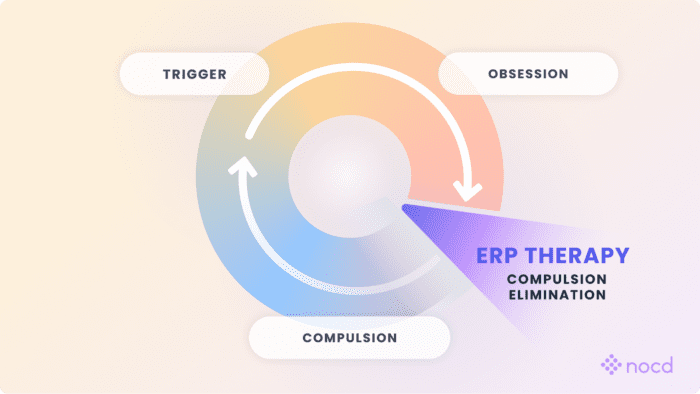
Magical Thinking OCD, like all forms of OCD, involves obsessions and compulsions.
Obsessions are intrusive thoughts, images, urges, feelings, or sensations that create distress. In Magical Thinking OCD, they often involve the fear that a thought, action, object, word, number, or routine has the power to cause—or prevent—harm.
Compulsions are mental or physical behaviors done to relieve distress, prevent a feared outcome, or make things feel safe. In Magical Thinking OCD, that might mean avoiding certain numbers, repeating phrases, following rigid rules, or trying to “undo” a thought that feels dangerous.
Here are some examples of how Magical Thinking OCD can show up:
| Example Obsession | Example Compulsion |
| “If I say that word out loud, it will bring bad luck.” | Silently repeating a “safe” word to cancel out the fear. |
| “If I sign this document with a red pen, this decision will end in disaster.” | Refusing to use the pen and choosing a “safer” color instead. |
| “If I look at the clock at 3:33p.m., someone I care about will have an awful day.” | Repeatedly checking the time so you don’t accidentally see 3:33. |
| “If I don’t call my family before this flight takes off, the plane will crash.” | Refusing to board the plane until you’ve contacted your family. |
| “If I knock on the door an even number of times, it will be bad luck.” | Always knocking an odd number of times. |
Magical Thinking OCD looks different from person to person. But while the specific fear or ritual may change, the pattern stays the same: something starts to feel tied to safety, danger, luck, or harm, and compulsions become a way to prevent a feared outcome.
Why are Magical Thinking OCD habits so hard to break?
Magical Thinking OCD can be hard to break free from because the compulsions don’t always feel purely negative. They may be stressful, exhausting, or time-consuming—but they can also create a powerful sense of control.
OCD can convince a person that their rituals are protecting them. If they repeat the phrase, avoid the number, check at the right time, or follow the rule exactly, it can feel like they prevented something bad from happening. Over time, that can make the ritual feel less like a symptom and more like a gift: “Maybe I know how to keep myself safe?” “Maybe I have a kind of intuition other people don’t?”
That feeling can even be euphoric. It can leave a person feeling as if they have a charmed life.
But the cost is high, and the sense of control doesn’t last. OCD keeps raising the stakes, demanding new rules, and making ordinary choices feel dangerous. A compulsion may bring relief–or even a fleeting sense of power–but it also reinforces the belief that the ritual mattered. The next time fear shows up, OCD has more evidence to point to: “I did the ritual last time, and everything turned out okay. Better do it again.”

Find the right OCD therapist for you
All our therapists are licensed and trained in exposure and response prevention therapy (ERP), the gold standard treatment for OCD.
How is Magical Thinking OCD treated?
Magical Thinking OCD can feel convincing and difficult to resist, but it responds well to treatment.
The most effective treatment for OCD is exposure and response prevention (ERP) therapy, a specialized form of cognitive behavioral therapy (CBT). General CBT, if not tailored for OCD, can sometimes be unhelpful or even worsen symptoms.
ERP helps people gradually face distressing thoughts, situations, numbers, words, objects, or routines without performing compulsions to feel safe or prevent a feared outcome. For someone with Magical Thinking OCD, that might look like:
- Signing a document with a red pen instead of a “safer” blue pen.
- Looking at the clock when it reads 3:33 p.m. without performing a ritual to cancel out the “bad luck.”
- Boarding a flight without contacting family members first to prevent something bad from happening.
- Knocking on a door an even number of times without knocking again to make the number feel safe.
Over time, ERP helps the brain learn that thoughts, numbers, words, objects, and routines don’t have to be treated like signs, warnings, or rules. The goal isn’t to prove that nothing bad will happen. It’s to practice living with uncertainty without letting OCD decide what you’re allowed to do.
ERP can make a meaningful difference: in NOCD clinical data, members treated for Magical Thinking OCD saw a 40% reduction in symptom severity on average.
ERP is sometimes combined with other approaches, including:
- Medication, particularly selective serotonin reuptake inhibitors (SSRIs)
- Mindfulness-based strategies
- Acceptance and commitment therapy (ACT)
Severe or treatment-resistant OCD may sometimes require higher levels of care, such as intensive outpatient programs (IOPs), partial hospitalization programs (PHPs), residential treatment, or other specialized interventions like transcranial magnetic stimulation (TMS).
Bottom line
Magical Thinking OCD can make thoughts, numbers, words, objects, or routines feel like they have the power to protect you from harm—or put you in danger if you don’t follow OCD’s rules.
Even when part of you knows the connection doesn’t make sense, the fear can still feel urgent. Compulsions may bring temporary relief, comfort, or even a sense of control, but they keep reinforcing the belief that the ritual was necessary.
You don’t have to prove that every thought is harmless or every choice is safe before you’re allowed to move forward. With ERP therapy, you can learn to face uncertainty without letting OCD decide what your life has to revolve around.