


“I think I may be coveting my own wife.”
“I’m meek, but I could probably stand to be meeker.”
“I think I may have swallowed a toothpick.”
Ned Flanders made those calls to Reverend Lovejoy in 1997, and The Simpsons played them as punchlines.
But they’re also one of the best depictions of obsessive-compulsive disorder (OCD) on television.
The Simpsons and OCD
Using The Simpsons as an OCD example might seem odd.
Season 29’s “Lisa Gets the Blues” establishes that Marge has OCD—in a single throwaway gag. But the show’s portrayal of Marge’s “OCD” is, at best, reductive.
Marge is a compulsive cleaner (“Regarding Margie,” S17E20), a gambling addict (”$pringfield,” S5E10), and a woman prone to mental breakdowns (“Homer Alone,” S3E15). So, they diagnosed her with OCD.
No, it’s not a good representation.
While cleaning is one of the most familiar stereotypes about OCD, the OCD cycle—obsession, distress, compulsion, brief relief—isn’t particularly visible in Marge.
Nevertheless, in Marge we trust
“In Marge We Trust” (Season 8, Episode 22) opens on Bart and Lisa hunched in front of the TV early Sunday morning, watching Itchy and Scratchy with the volume low so they don’t wake their parents. It doesn’t work. Marge hears the kids’ laughter, jolts awake, and discovers the family is late for church. Homer negotiates.
Marge: The Lord only asks for an hour a week.
Homer: In that case, he should have made the week an hour longer.
It’s hard to blame Homer for his reluctance once we get a taste of Reverend Lovejoy’s sermon. By the end, most of the congregation is in a half-asleep stupor.
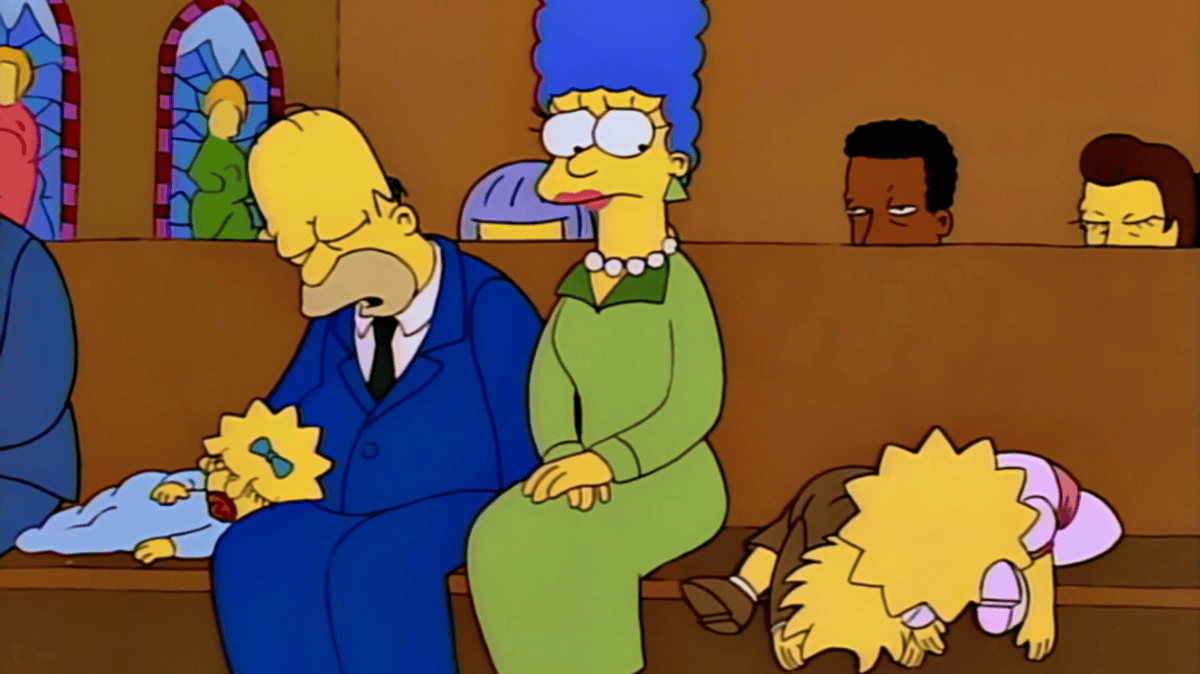
The scene when the family arrives home can only be described as jubilation. The kids peel off their church clothes and celebrate their favorite time of the week: the longest possible time before more church. Marge objects: church shouldn’t be a chore, it should help you in your daily life. It’s the standard she’s about to hold Lovejoy to.
Marge volunteers at the church and asks Lovejoy if the church could be doing more for the community. The phone interrupts. It’s Principal Skinner, calling about his mother, who has started putting cardboard over “her half of the television.”
Skinner: What should I do?
Lovejoy: Well, maybe you should read your Bible.
Skinner: Um, any particular passage?
Lovejoy: Oh, it’s all good.
Skinner’s problem may be small, but Lovejoy’s indifference isn’t. Marge points out that a man asked for help and got nothing.
Lovejoy tells her he used to care. Then he met someone who changed everything.
“Reverend, I’m afraid something terrible has happened”
To most Simpsons fans, Ned Flanders is the family’s successful, tediously moral, and occasionally misguided neighbor.
To Homer, Ned is whatever the plot demands: an annoyance, a one-sided rival, and—at least once—a short-term best friend.
But to Reverend Lovejoy, Ned Flanders is an albatross.
In a flashback, we see Lovejoy arrive in Springfield in the ‘70s, guitar in hand, fresh out of seminary. A bright-eyed reverend eager to make a difference for his new congregation.
Then the calls began.
Flanders: Reverend, I’m afraid something terrible has happened…. I was talked into doing a dance called “The Bump,” but my hip slipped and my…my buttocks came into contact with the buttocks of another young man.
Flanders: I think I may be coveting my own wife.
Flanders: I’m meek, but I could probably stand to be meeker.
Flanders: I think I may have swallowed a toothpick.
Lovejoy: Finally, I just stopped caring.

Am I okay?
Look at what Ned actually wants from these calls.
He isn’t asking Lovejoy to help him understand scripture, and he isn’t working through a genuine moral dilemma. He’s asking the same question dressed up four different ways: “Am I okay?“
That distinction matters. Faith necessarily leaves room for uncertainty. Believers live with unanswered questions about suffering, doubt, and whether anyone is actually listening. Not knowing is the whole deal.
But for Ned, not knowing is an emergency. He’s chasing certainty, and he wants Reverend Lovejoy to provide it. That’s the pattern at the heart of Scrupulosity OCD: obsessive fears about sin, morality, or violating deeply held beliefs, followed by compulsions meant to resolve the doubt or relieve the distress it causes.
For Ned, that compulsion is reassurance-seeking. He calls Lovejoy, gets an answer, and (presumably) feels better…briefly. But the relief teaches him that his doubt required an answer. So when another doubt appears, he picks up the phone and calls again.
Reassurance-seeking is one of the most common compulsion patterns in OCD, and it’s insidious precisely because it can look healthy. It’s important to ask for help. It can be useful to consult your pastor, priest, imam, or rabbi. But when each answer is being used to make uncertainty go away, the conversation becomes part of the OCD cycle.
The joke is that Ned wore Lovejoy out. But Lovejoy was recruited into his compulsions simply by answering the phone, doing his job, and trying to be decent. Neither man understood what was happening, but that didn’t change the outcome. Ned’s OCD burned Lovejoy out.
Ned’s OCD cost a congregation an engaged minister.

Find the right OCD therapist for you
All our therapists are licensed and trained in exposure and response prevention therapy (ERP), the gold standard treatment for OCD.
Bottom line
Scrupulosity itself isn’t a crisis of faith. It’s a disorder that attacks through your faith, and the treatment is exposure and response prevention (ERP)—not an endless supply of answers.
That can feel like a betrayal. If the doubts are about sin and scripture, shouldn’t the answer come from someone who can speak to that?
But treatment isn’t a verdict on your beliefs. For many people, treatment can actually help them reclaim their faith, because when a religious practice is organized around compulsions, OCD—not faith—is setting the terms.
A faith leader for your faith. A therapist for the condition attacking it.