As the world’s largest specialty treatment company for obsessive-compulsive disorder (OCD), NOCD works with thousands of people living with the condition. That experience has also given us something valuable: a clear picture of how OCD affects people across our community.
That broader perspective also lets us explore a more specific question: Which OCD themes come up most often among the people we work with?
The ten most common OCD subtypes, according to NOCD data
We looked at which OCD topics 27,000 Members follow in the NOCD online community. Following a topic doesn’t necessarily mean someone has that subtype (they may be curious, or supporting a loved one), but it’s a useful snapshot of the themes our community engages with most.
Members can follow multiple topics, so the percentages add up to more than 100%.
| OCD Subtype | % of Members Following |
| Relationship OCD | 52% |
| “Pure O” OCD | 51% |
| “Just Right” (Perfectionism) OCD | 45% |
| Real Event OCD | 36% |
| Harm OCD | 34% |
| Health Concern OCD | 32% |
| False Memory OCD | 30% |
| Contamination OCD | 30% |
| Magical Thinking OCD | 24% |
| Religion and Spirituality OCD | 22% |
Relationship OCD
People with Relationship OCD experience intrusive thoughts and compulsions related to their relationships with others, including romantic partners, friends, family members, and even coworkers. While it’s normal to have occasional doubts about your relationships, people with Relationship OCD have difficulty moving on from these doubts and engage in compulsions to find relief.
Example relationship obsessions
- “I had a dream last night about my ex. Does that mean that I’m in the wrong relationship now?”
- “My friend hasn’t responded to my message. Are they mad at me?”
- “What if I don’t love my family as much as I should?”
Example relationship compulsions
- Repeatedly asking a friend if they’re upset with you.
- Seeking reassurance from others that you’re a good friend, partner, family member, or colleague.
- Mentally reviewing interactions to determine whether you said something wrong.
“Pure O” OCD
Unlike other kinds of OCD that may involve obvious, visible rituals, ”Pure O” OCD involves compulsions that happen primarily inside a person’s mind. Obsessions can encompass virtually any subject, including those found in other subtypes.
Despite the name, “Pure O” doesn’t mean someone experiences obsessions without compulsions. Mental compulsions can occur in any OCD subtype, so “Pure O” often co-occurs with other subtypes.
Example “Pure O” compulsions
- Mentally replaying past events or conversations to check whether something went wrong.
- Silently repeating words, phrases, or numbers until they feel “right.”
- Counting objects or actions in your head to neutralize an unwanted thought or prevent something bad from happening.
“Just Right” (Perfectionism) OCD
One of the more traditionally recognizable themes of OCD, “Just Right” (Perfectionism) OCD involves obsessions and compulsions related to organization, perfection, and making things feel right.
It’s more than just perfectionism as a personality trait. People with “Just Right” OCD may feel that something is wrong, uneven, or incomplete until they perform certain rituals.
Example “Just Right” obsessions
- “Someone touched my right arm, and it feels ‘off.’ I have to touch my left arm to even it out.”
- “Something bad is going to happen to me if I don’t even out the way these books are arranged on my bookshelf.”
- “I feel very off and I can’t concentrate because things aren’t perfect. What if I never feel normal again?”
Example “Just Right” compulsions
- Performing action over and over to reach a certain number that feels “right.”
- Reorganizing things to make them even or complete.
- Redoing work or school tasks until they feel perfect.
Real Event OCD
Real Event OCD involves becoming fixated on something you did, said, or experienced in the past. This might be a mistake, an awkward interaction, a moment of poor judgment, or a situation where you may have caused harm. Even after apologizing, taking responsibility, or trying to move on, you may struggle with persistent guilt and doubts about what happened or what it means about you.
Example real event obsessions
- “What if something I did in the past proves I’m a bad person?”
- “What if I traumatized someone during that argument?”
- “What if I deserve to be rejected or judged for something I did in the past?”
Example real event compulsions
- Repeatedly replaying past events or conversations to analyze what happened.
- Researching laws, morality, or similar situations online to determine whether you did something wrong.
- Seeking reassurance from others that you’re not a bad person or that you’ve been forgiven.
Harm OCD
Harm OCD involves intrusive thoughts, images, or urges about intentionally or accidentally hurting yourself or other people. These thoughts are common and don’t necessarily reflect someone’s desires or intentions. But with Harm OCD, you may become consumed by fears about what they mean about you—or whether you might act on them.
Example harm obsessions
- “What if I just drove off this cliff right now?”
- “I could hurt my family with this kitchen knife.”
- “I just had an unwanted thought about hurting my child. Does that mean I want to do it?”
Example harm compulsions
- Avoiding loved ones out of fear that you might hurt them.
- Removing knives or other potentially dangerous objects from your surroundings to prevent feared harm.
- Seeking reassurance from others that you’re not capable of hurting someone.
Health Concern OCD
Health Concern OCD involves persistent fears about having or developing a serious medical condition. You might become preoccupied with ordinary bodily sensations, worry that you’ve overlooked signs of an illness, or struggle to trust medical test results.
Example health concern obsessions
- “What if this headache is a sign of a brain tumor?”
- “My doctor says I’m healthy, but what if they missed something?”
- “What if I develop a serious illness and don’t recognize the symptoms until it’s too late?”
Example health concern compulsions
- Repeatedly checking your body for lumps, changes, or other signs of illness.
- Searching online for symptoms and possible diagnoses.
- Seeking repeated medical tests or appointments to make sure nothing was missed.
False Memory OCD
False Memory OCD involves intrusive doubts about past events and memories. You might fear that you hurt someone, acted immorally, or committed a serious mistake—even when there’s little or no evidence it happened. These doubts can make it difficult to trust your memory, leaving you questioning what you may or may not have done.
Example false memory obsessions
- “Have I committed a crime that I can’t remember?”
- “What if I hurt someone while driving without realizing it?”
- “What if I cheated on my partner and don’t remember?”
Example false memory compulsions
- Repeatedly asking others to confirm what happened.
- Mentally reviewing memories to search for evidence of wrongdoing.
- Searching for photos, videos, or other evidence to verify your memories.
Contamination OCD
Contamination OCD involves intrusive fears about germs, illness, dirt, or other sources of contamination. People with this subtype may worry about becoming contaminated themselves or spreading contamination to others. These fears aren’t always about physical substances—some people experience emotional contamination, where contact with a person, place, or idea creates a feeling of being dirty or contaminated.
Example contamination obsessions
- “Lots of other people have touched this doorknob. Am I going to get sick from touching it?”
- “I accidentally touched someone. What if I transferred germs to them and made them sick?”
- “I spent time with someone who treated me badly. What if something about them rubbed off on me?”
Examples contamination compulsions
- Avoiding places, people, or objects that feel contaminated.
- Repeatedly washing your hands or cleaning surfaces.
- Throwing away food or belongings out of fear that they’re contaminated.
Magical Thinking OCD
Magical Thinking OCD involves intrusive fears that certain thoughts, actions, objects, words, or numbers can cause or prevent events they have no actual connection to. You might feel that thinking something bad could make it happen, or that following a particular ritual is the only way to keep yourself or someone else safe.
Example magical thinking obsessions
- “If I say that word out loud, will it bring bad luck?”
- “What if signing this document with a red pen causes something terrible to happen?”
- “If I don’t call my family before my flight, what if the plane crashes?”
Example magical thinking compulsions
- Silently repeating a “safe” word to cancel out an unwanted thought.
- Avoiding certain numbers, words, or objects believed to bring bad luck.
- Following rigid routines or rituals to prevent something bad from happening.
Religion and Spirituality OCD
Religion and Spirituality OCD (also known as Scrupulosity OCD) involves intrusive fears and doubts about religious or spiritual beliefs, practices, and obligations. People with this subtype may worry that they’ve sinned, offended God, failed to follow religious rules correctly, or put their spiritual well-being at risk.
Example religious obsessions
- I did something that might be a sin. Will God forgive me?
- What if I’m not practicing my religion correctly?
- What if having a blasphemous thought means I’ve offended God?
Example religious compulsions
- Repeatedly going to confession to seek forgiveness.
- Praying over and over again until it feels right.
- Seeking reassurance from religious leaders about whether you’ve sinned or violated your beliefs.

Find the right OCD therapist for you
All our therapists are licensed and trained in exposure and response prevention therapy (ERP), the gold standard treatment for OCD.
The best way to treat all forms of OCD
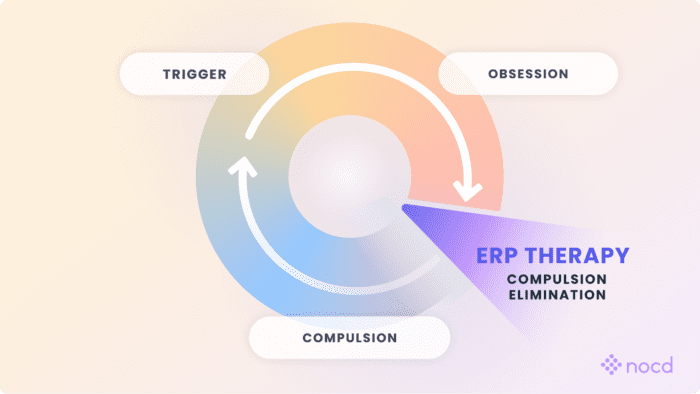
Regardless of the subtype, exposure and response prevention (ERP) therapy is the first-line psychological treatment for OCD. ERP helps people gradually face the thoughts, feelings, and situations that trigger their symptoms while practicing resisting compulsions.
“OCD is OCD across the board, and the things we’re really treating with ERP is an intolerance of uncertainty, doubt, and discomfort,” explains NOCD therapist and clinical trainer April Kilduff. “The subtypes are just different ways of expressing that uncertainty, doubt, and discomfort. Some tools click better with certain people, but the same basic treatment has been shown to work across the board in a matter of months.”
If you’re interested in learning more about ERP, schedule a free 15-minute call with the NOCD team.