

Sometimes your body reacts in ways that don’t match how you feel.
You might notice a sensation in your groin—like tingling, warmth, or arousal—at the exact moment a disturbing thought or unwanted image pops into your mind. That mismatch can be confusing, unsettling, or even frightening.
If this has happened to you, it’s nothing to fear. Many people assume that physical arousal always reflects desire, but the body doesn’t always work that way. You can experience a groinal response even when your mind rejects what’s happening.
What is a groinal response?
A groinal response is a physical sensation of arousal in the genital area. It may include:
- Tingling
- Warmth
- Swelling or a feeling of fullness (sometimes called tumescence)
- Moisture or lubrication
- Increased sensitivity to movement or touch
- Partial or full erection
People of any gender, sex, or age can experience groinal responses. While this term specifically refers to feelings of arousal in the genital region, a person may feel unwanted or distressing arousal in other parts of their body as well (e.g., blushing or an elevated heart rate).
Why do groinal responses happen?
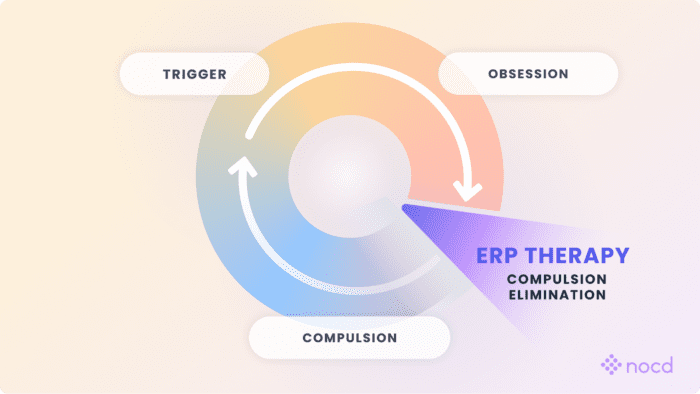
In some cases, groinal responses are connected to obsessive-compulsive disorder (OCD). In OCD, they are often linked to obsessions–unwanted, intrusive thoughts, images, urges, feelings, or sensations that cause significant anxiety or distress.
Groinal responses do not necessarily reflect sexual desire. This is due to a phenomenon called arousal non-concordance, where the body may respond physically even when you do not actually feel sexual attraction.
Common OCD subtypes that experience groinal responses include:
- Sexual Orientation OCD: Anxiety about being attracted to someone who doesn’t align with your gender preferences
- Sexual OCD: Distressing sexual thoughts, images, or urges that conflict with your values
- Relationship OCD: Intrusive doubts and fears about romantic, platonic, or familial relationships
- Pedophilia OCD: Distressing thoughts about harming or being sexually attracted to children
- Harm OCD: Fears about harming yourself or others, even though you have no desire or intent to do so
Groinal responses can also occur during other high-arousal emotional states, such as:
- Anxiety
- Joy
- Pain
- Excitement
An example of a groinal response in OCD
Fatima had struggled with OCD as a child, but around her 18th birthday a new symptom appeared: she began to notice intrusive sexual thoughts about women.
Fatima had never experienced any thoughts about being gay before, and never believed she was gay, but suddenly felt very unsure. The intrusive thoughts about being attracted to women were accompanied by an unwanted feeling of arousal in her genitals. The result was a great deal of anxiety.
To cope with the discomfort of her groinal response, Fatima developed some habits—like trying to distract herself by putting in her headphones when an intrusive thought appeared and scrolling on her phone. Some days, she deliberately stared at boys in her classroom whom she found attractive. But to Fatima’s surprise, the distraction never worked. Her self-doubt and fear continued to grow, and she couldn’t get her mind off the physical response.
OCD groinal response compulsions
In OCD, compulsions are repetitive behaviors or mental acts that a person feels driven to perform in response to an obsession or to reduce distress. When it comes to groinal responses, compulsions are ways a person may try to manage or neutralize the discomfort caused by unwanted physical sensations of arousal.
Examples of compulsions related to groinal responses include:
- Seeking reassurance from friends and family
- Searching online to see if groinal responses are normal
- Testing their groinal response by picturing images
- Adjusting the way they sit
- Walking a certain way
- Adjusting the way their clothes fit or wearing baggier clothes
- Avoiding public places or groups of people

Find the right OCD therapist for you
All our therapists are licensed and trained in exposure and response prevention therapy (ERP), the gold standard treatment for OCD.
What is the best way to respond to an unwanted groinal response?
Groinal response as a symptom of OCD can be effectively treated with exposure and response prevention (ERP) therapy, an evidence-based approach that has been shown to help people with all forms of OCD.
In ERP, a trained therapist works with you to gradually face situations, thoughts, or sensations that trigger anxiety—like groinal responses—while resisting the urge to perform compulsions or avoid triggers. Over time, this helps you tolerate distress without relying on compulsions, ultimately reducing anxiety and increasing confidence in your ability to live with uncertainty.
Therapists often guide patients using response prevention messages—short statements to remind you to resist compulsions and sit with uncomfortable sensations. Examples for groinal responses include:
- “Who knows if I’ll have this aroused feeling at an inappropriate time. I guess I’ll never know.”
- “This feeling may or may not mean I’m ___________.”
- “I may or may not be a monster because I am feeling this way.”
- “You might be right, OCD. I will never be able to control this arousal feeling. Oh well!”
It’s very different from talk therapy because it involves actively facing fears instead of avoiding them. The process is personalized for each person, so patients are gradually exposed to triggers without becoming overwhelmed.