



If you love someone with obsessive-compulsive disorder (OCD), body-focused repetitive behaviors (BFRBs) like skin-picking and hair-pulling, or tic disorders, you may be wondering what to say, what to avoid, and how you can effectively support your loved one. You’re not alone—the loved ones of people living with these conditions often struggle to figure out the best ways to support the people they care about.
And if you’re the person living with any of these conditions, you may know that feeling from the other side. Maybe you’ve wished that the people around you better understood what you’re experiencing, or felt frustrated by responses like “Just stop,” or “Don’t do that.”
The good news is that effectively supporting someone with OCD, BFRBs, or tics is a skill that can be learned. But first and foremost, it’s important to understand that support from loved ones works best alongside the right treatment. One of the most meaningful things you can do is encourage your loved one to work with a therapist who specializes in evidence-based care for these conditions, like exposure and response prevention (ERP) therapy for OCD and habit reversal training (HRT) for BFRBs.
Whether you’re reading for yourself or for someone you love, here are five strategies that can complement that treatment, giving you shared language and a clearer sense of how to show up for each other.
1. Stop saying “stop”—and try a different response
When people start to notice that their loved ones are doing compulsions, skin picking, hair pulling, or tics, they may think that these behaviors are easy to stop at first. By saying “stop,” they might be hoping to help the person build awareness and learn to resist the urge to do these behaviors. Unfortunately, this may only lead to shame and embarrassment, which actually has the opposite effect: Shame can cause one to do compulsions, BFRBs, and tics even more frequently.
If someone is just starting to learn how to manage compulsions, BFRBs, or tics, they themselves may not even be aware that they are doing the behavior. So, instead of telling them to stop, it’s important to first acknowledge what might be happening inside their mind and empathize with them. You don’t need to try to be their therapist, but you can help them build awareness.
With compulsions and BFRBs, it should be noted the behaviors are sometimes more easily controlled by the person if they have a certain level of awareness. Tics, however, are involuntary and often not easily controlled.
To help your loved one build awareness, try to center the way that they might be feeling when they engage in these behaviors. Here are a few examples of ways you might respond:
- For compulsions: “I’m noticing that you’re repeating this behavior. Something really tough could be going on right now, but that’s just a guess. Do you notice any feelings or thoughts right now that may be affecting it? Maybe we can log this together and see what your therapist says.”
- For BFRBs: “I’m noticing some picking and pulling. I wonder what feeling you’re having right now—could it be boredom, anger, nervousness? Maybe we can log it and see what your therapist says.”
- For tics: Because tics aren’t voluntary, they can make a person feel helpless at times. A gentle cue, like a raised hand or a quiet acknowledgment, can help your loved one become more aware of the urges, feelings, or triggers that can come before a tic. Working your loved one and their therapists to choose a reminder they’re comfortable with, such as a code word or subtle signal, can make building that awareness feel more supportive.
2. Validate your loved one’s feelings, but don’t provide reassurance
If you notice a loved one asking you questions in a compulsive way, like: “Am I crazy? Am I a bad person? Did I do something wrong? Are you mad at me?” try to avoid answering with a statement like, “No, you’re okay. Don’t worry!” This is an example of reassurance, and seeking reassurance is a common compulsion.
Instead, you can support a loved one with OCD by saying something along these lines: “I notice you’re seeking reassurance or wanting to feel okay right now. I’m choosing not to reassure you because I know that feeds OCD, and I care about you too much to do that. I’m going to stay right here with you while you sit with this feeling.” You can even create a code word or a name for OCD—sometimes this can make you both laugh, or help with resisting compulsions.
When it comes to BFRBs, if a loved one asks you for reassurance—“Do I look weird or ugly?”—after picking their skin or pulling their hair, you can say something like this instead: “I know it can be hard to see a scab or hair missing. What can help you resist the urge next time?”
And for tics, if a loved one asks, “Am I always going to be this way?” you can say, “We will try to find competing responses to make this easier to manage.”
3. Suggest alternatives to the behavior
Sometimes it can be hard for a loved one to remember ways to resist their compulsions, or to use competing responses for BFRBs or tics. In these cases, visual reminders around the house can be helpful—like this example from Natasha Daniels’s AT Parenting:
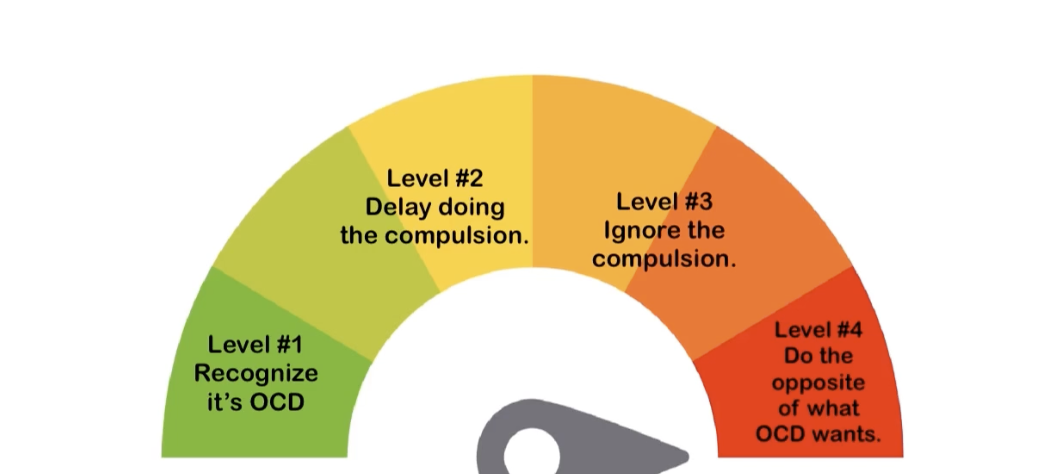
If you’re supporting a child, reading children’s books together can be a great way to bond while also reminding your loved one how to handle OCD: Billie v. the OCD Monster, Blink, Blink, Clop, Clop, Wilma Jean the Worry Machine, Something Might Happen, and Don’t Feed the Worry Bug are a few great examples.
If you’re supporting an adult, there are books about OCD and mental health that may better help them understand their experiences. Sending them podcasts about OCD and related conditions like OCD Stories or AT Parenting Survival Podcast can be a great way to share and talk about challenges, too.
4. Understand that there will be challenges, and do your best to accept them
ERP and HRT can be challenging treatments at times. There may be moments when your loved one feels frustrated and wants to give up. Their OCD, BFRBs, or tics can occasionally get more active depending on stressors and treatment progress. If this happens, remind your loved one that recovery isn’t linear, and perfection isn’t possible.
While your loved one is in treatment, your presence can be a pillar of support for them in between sessions. Maybe they can watch videos with you to stay motivated, like Kicking Childhood OCD to the Curb or AT Parenting Survival School. You can also help them build positive coping skills that bring them joy and connect them to their values—perhaps by volunteering, making something, or going on walks and exercising together.
As your loved one continues their treatment, do your best to stay firm and consistent with boundaries and reminders. If they slip up, remain supportive, but don’t give into compulsions. Encourage them to do exposures, and reward them for challenging themselves.
5. Be compassionate with them—and yourself
It may feel frustrating if you don’t see the level of progress or rate of progress that you’re hoping for in your loved one. Understand that your loved one is likely frustrated as well. They likely want to feel better as quickly as possible, and they may sometimes feel angry with you and themselves if it isn’t happening at the speed they hoped.
If anger arises, allow it to be there, but also remember to be kind to yourself and your loved one. OCD, BFRBs, and tics don’t just go away, and learning to manage them often requires time, effort, and patience. It’s important to practice self-compassion throughout this process—realizing when you and your loved one are doing your best, and recognizing when you might be able to push yourselves to grow or invest more energy in what you’re practicing.
Sources of support are key to getting better
When your loved one is suffering from OCD, BFRBs, or tics, getting better can be difficult for them to accomplish alone. But with evidence-based treatment and the support of loved ones who know effective ways to provide understanding and motivation, people can learn to manage their symptoms and get back to living the lives they want to live.
If you or a loved one may be suffering from OCD or a related condition, NOCD can help. Our licensed, specialty-trained therapists use exposure and response prevention (ERP) therapy to treat all subtypes of OCD, and many NOCD Therapists have also received specialty training in treating BFRBs and tic disorders. You can book a free 15-minute call with our team to learn more about working with a NOCD Therapist and accessing support between sessions, including dozens of virtual support groups, with meetings nearly every day of the week.
For loved ones of NOCD Therapy Members, we also offer NOCD 411 sessions, which provide guidance and education on how to effectively support someone living with OCD, and a dedicated support group for support system members.


