

Something feels off in your relationship. Is it anxiety—or something real?
What is relationship anxiety?
We’ve all been there. You’re in love. Everything’s going great.
Well—almost everything.
But lately, you have a gut feeling you just can’t shake. Is this real? Will it last? What if my partner is hiding something?
It’s normal to have doubts. Relationships can bring up fears about trust, compatibility, vulnerability, and the future—especially when you deeply care about someone. But when the questions won’t stop—when they start crowding out everything else—that’s relationship anxiety.
Relationship anxiety doesn’t always look dramatic. Sometimes it shows up quietly: rereading old conversations for hidden meaning, feeling panicked when your partner takes longer than usual to text back, or needing repeated confirmation that everything is okay after a disagreement.
Over time, relationship anxiety can make it hard to feel present or secure in your relationship. Instead of enjoying your connection with your partner, you may find yourself rereading texts, overthinking small changes in tone, or wondering whether a perfectly normal disagreement means the relationship is doomed.
Signs of relationship anxiety
Relationship anxiety looks different for everyone, but it tends to show up in recognizable patterns. Do any of these sound familiar?
- Overanalyzing your partner’s words, tone, or behavior
- Wondering whether your partner truly loves you, even when things are going well
- A gut feeling that your partner will leave you, even when there’s no reason to think they will
- Seeking constant reassurance, but never feeling settled by it
- Testing your partner or picking fights to gauge their reaction
- Comparing your relationship to others and always coming up short
- Questioning your attraction to your partner or doubting your compatibility
But what if something is actually wrong?
Here’s where things get complicated. Many of the behaviors associated with relationship anxiety—overanalyzing, seeking reassurance, constantly worrying—can also happen when a relationship genuinely feels unstable or unsafe. If your partner is distant, dishonest, inconsistent, or emotionally unavailable, persistent concern may not be disproportionate.
In other words, anxiety isn’t defined by the presence of fear alone. It’s about whether the intensity of your fear matches the reality of the situation.
According to Dr. Patrick McGrath, Chief Clinical Officer at NOCD, one helpful question to ask yourself is whether your fears are primarily driven by possibilities—or by concrete experiences.
If you’re asking ‘what if’ but have no actual proof to back it up, that’s probably anxiety. A legitimate concern is grounded in something real—something you’ve actually seen, heard, or experienced.
Dr. Patrick McGrath, NOCD Chief Clinical Officer
Relationship concerns are usually connected to consistent patterns you can clearly point to. Maybe your partner frequently lies, dismisses your feelings, avoids communication, or breaks you trust. Relationship anxiety, on the other hand, often fills in uncertainty with worst-case interpretations—even when there’s little concrete evidence something is wrong.
What causes relationship anxiety?
So if there’s nothing tangibly wrong—if your partner is showing up, being honest, and giving you no real reason for concern—why can’t you shake the feeling in your gut?
Here are some common reasons relationship anxiety can happen:
- Past experiences. If you’ve been hurt before (lied to, left without warning, or let down by people who were supposed to show up for you) your nervous system remembers. Past experiences can train your mind to stay alert for signs of rejection, betrayal, or loss. Trust issues are one of the most common ways this shows up—and overthinking after being cheated on is a particularly hard pattern to break.
- Stress or major life transitions. Big relationship milestones or stressful periods can make existing fears feel louder. Moving in together, getting engaged, starting a family, or other difficult life transitions can all trigger relationship anxiety—even in otherwise healthy relationships.
- Low self-esteem. When you don’t feel worthy of love, it’s hard to believe your partner’s love is real or lasting, even when they’re showing up consistently. Research has found that people with low self-esteem are more likely to underestimate how positively their partners see them, which can contribute to insecurity and relationship doubt.
- Generalized anxiety disorder. Sometimes relationship anxiety has little to do with the relationship itself. For people with generalized anxiety disorder (GAD), persistent worry is often the baseline—and relationships can be an easy target for those fears.
- Attachment style. The way you learned to connect with people early in life tends to follow you into romantic relationships. Research has linked anxious attachment styles to greater relationship rumination, fear of abandonment, and lower relationship satisfaction. Avoidant attachment can make closeness feel threatening, causing you to pull away when relationships become more emotionally intimate. Disorganized attachment can create both patterns at once—craving closeness while also fearing it.
- Obsessive-compulsive disorder. For some people, relationship anxiety isn’t just anxiety—it’s obsessive-compulsive disorder (OCD). If reassurance never sticks no matter how much you get, or the doubts feel completely uncontrollable, it may be worth asking whether something more is going on.
Could it actually be Relationship OCD?
For some people, relationship anxiety doesn’t just lead to worry—it becomes obsessive, consuming, and nearly impossible to let go of.
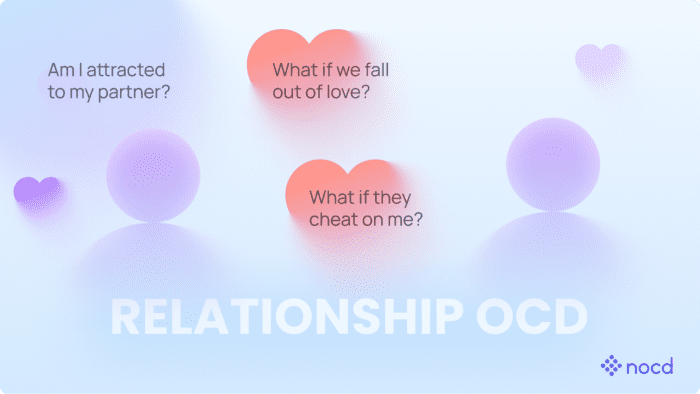
This may be a sign of Relationship OCD (ROCD), a subtype of obsessive-compulsive disorder centered on relationships, attraction, love, or compatibility.
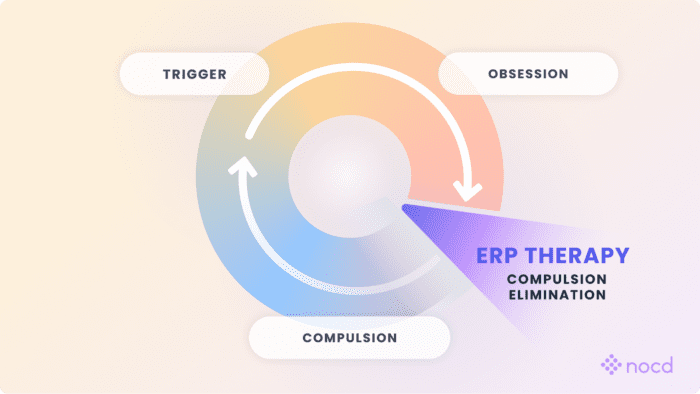
People with ROCD experience intrusive thoughts and fears (or obsessions) about their relationship, then feel driven to do something to relieve the anxiety those thoughts create. These behaviors are called compulsions, and they can be physical or mental.
Some common compulsions in ROCD include:
- Constantly seeking reassurance from friends, family, or your partner
- Mentally reviewing interactions for “proof” that the relationship is right or wrong
- Comparing your relationship to other people’s relationships
- Checking your feelings to see whether you’re “still in love”
- Googling relationship advice compulsively
- Repeatedly questioning whether your partner is attractive enough, compatible enough, or “the one”
For example, someone might see their neighbors holding hands and kissing in the yard and suddenly start wondering how long it’s been since that happened in their own relationship. They may begin comparing their relationship to other people’s relationships and questioning whether it means something is wrong or whether other couples are happier than they are.
Someone without relationship anxiety or ROCD, on the other hand, might see the same thing and think, “We haven’t done that in a while,” then make an effort to create more moments of connection with their partner.
How to deal with relationship anxiety
Relationship anxiety is manageable. But the goal can’t be to eliminate every fear or question that comes up in your relationship. The goal is learning how to respond to those thoughts without letting them control your emotions, behaviors, or decisions.
Stop treating every fear like an emergency
Is the relationship right? Does your partner love you? Is something wrong?
These questions create a false sense of urgency.
But you don’t need to analyze every anxious thought. In healthy relationships, uncertainty is normal. Learning to tolerate it—instead of eliminating it completely—can help break the cycle of overthinking.
Pay attention to reassurance-seeking behaviors
Seeking relief from doubt is one of the most common patterns in relationship anxiety. The problem is that the relief usually doesn’t last long. Over time, constantly trying to eliminate uncertainty can actually strengthen anxiety by teaching your brain that doubt is dangerous and must always be resolved.
Take care of your mental and physical health
Stress, poor sleep, burnout, and emotional exhaustion can all make anxiety feel louder. Taking care of your nervous system won’t solve every relationship concern, but it can make it easier to respond thoughtfully instead of reactively.
“Sleep well, get good exercise, eat properly, and do everything you can to keep yourself in the best health possible,” says Dr. McGrath.
Consider therapy if the anxiety is affecting your life or relationship
When the weight of relationship anxiety becomes too heavy to carry alone, professional support can offer a path forward. The right therapeutic approach often depends on the root of your fears.
For some people, cognitive behavioral therapy (CBT), attachment-focused therapy, or couples therapy can help address underlying fears, communication patterns, or self-esteem issues.
But OCD usually requires a specialized approach. If the doubts feel obsessive, repetitive, and impossible to let go of—especially if you find yourself trapped in compulsive checking, overanalysis, or mental review—exposure and response prevention (ERP) therapy is considered the gold standard treatment for OCD.
If your doubts feel all-consuming, taking our OCD quiz can be a vital first step in gaining clarity and understanding your experience.

Find the right OCD therapist for you
All our therapists are licensed and trained in exposure and response prevention therapy (ERP), the gold standard treatment for OCD.
Bottom Line
Relationship anxiety can make even healthy relationships feel heavy, fragile, or hard to trust. But you don’t need to resolve every gut feeling or achieve perfect certainty to build a strong relationship. Learning how to respond to fear without getting trapped in overanalysis, reassurance-seeking, or worst-case thinking can help you feel more grounded in both yourself and your relationship.