


What if one wrong choice could put your baby in danger?
That fear can show up during pregnancy and follow you into new parenthood. Decisions that once seemed manageable can start to feel loaded with risk, and even careful choices may leave you wondering whether you missed something.
Trying to reach complete certainty that your baby is safe can pull you into more checking, researching, avoiding, and reassurance-seeking—without ever making the doubt feel settled.
What is Perinatal OCD?
Perinatal OCD refers to obsessive-compulsive disorder (OCD) that begins or worsens during pregnancy or after childbirth. It can cause expectant and new parents to become preoccupied with fears about their baby’s safety or their ability to care for them. People with Perinatal OCD may worry that they could accidentally or intentionally harm their baby, overlook a serious danger, or fail to protect their baby. These thoughts feel intrusive, distressing, and difficult to dismiss, often leading to cycles of checking, avoiding, researching, and seeking reassurance.
OCD symptoms can begin or worsen during pregnancy or after childbirth. Hormonal changes and the stress of caring for a baby may contribute to new symptoms or intensify OCD that was already present.
Does this mean I’m going to be a bad parent?
Intrusive thoughts, feelings, urges, images, or sensations can feel like warnings about the kind of parent you’ll become. They may leave you wondering: What if I don’t bond with my baby? What if I make a terrible mistake? What if I lose control?
But OCD does not predict how you will care for your child. A frightening thought or intrusive urge does not mean you intend to act on it. An urge is not a decision. And a moment of fear, numbness, or disconnection is not a forecast of the relationship you will have with your baby. In Perinatal OCD, these experiences are symptoms of a treatable condition—not evidence that you will be a bad parent.
Having a frightening thought does not mean you want it to happen or that it reflects the kind of parent you are.
April Kilduff, MA, LCPC, LMHC, LPC
What does Perinatal OCD look like?
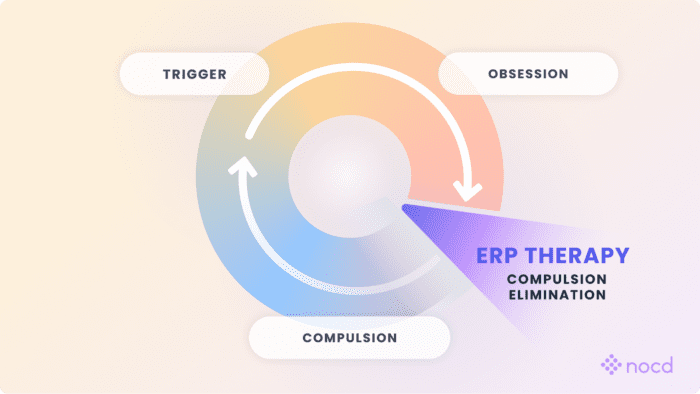
People with Perinatal OCD often engage in physical or mental behaviors (compulsions) to reduce distress caused by intrusive thoughts, feelings, urges, images, or sensations (obsessions) about their pregnancy, their baby’s safety, or their ability to care for them.
While compulsions may provide temporary relief, they ultimately reinforce the OCD cycle and make intrusive fears more persistent over time.
Here are a few examples of how Perinatal OCD can show up in daily life:
| Obsession | Compulsion |
| “What if something I ate or touched harmed my baby?” | Spending hours researching foods, medications, products, or exposures to determine whether they were safe |
| “What if I miss a sign that something is wrong with the pregnancy?” | Checking bodily sensations or fetal movement far more often than medical guidance calls for |
| “What if I lose control and hurt my baby after they’re born?” | Avoiding holding the baby or caring for them alone |
| “What if I don’t love my baby as much as a parent should?” | Mentally reviewing your feelings and interactions to decide whether you feel enough love or attachment |
| “What if having thoughts about harming my baby means I actually want to?” | Asking a partner, family member, or clinician to confirm that the thoughts do not mean you’re dangerous |
Perinatal OCD vs. depression and psychosis
Perinatal OCD is not the only mental health condition that can emerge during pregnancy or after a baby is born. Perinatal depression is a mood disorder that can cause persistent sadness, hopelessness, irritability, loss of interest, exhaustion, or difficulty functioning. Perinatal OCD, by contrast, centers on intrusive thoughts, images, feelings, sensations, or urges and the compulsions used to reduce distress or prevent a feared outcome. The two conditions can overlap, and some people experience both at the same time.
Postpartum psychosis, on the other hand, is a rare and severe condition that develops after childbirth and can involve hallucinations, delusions, paranoia, severe confusion, mania, or losing touch with reality. In Perinatal OCD, frightening thoughts are typically unwanted and distressing, and the person worries about what they might mean. In postpartum psychosis, a hallucination or delusional belief may be experienced as real. Perinatal OCD and postpartum psychosis are separate conditions, and having Perinatal OCD does not mean you will develop postpartum psychosis.
Postpartum psychosis is a medical emergency. If you or someone you know is hallucinating, experiencing delusions or severe confusion, losing touch with reality, or expressing an actual intention to harm themselves or the baby, seek emergency medical care immediately.

Find the right OCD therapist for you
All our therapists are licensed and trained in exposure and response prevention therapy (ERP), the gold standard treatment for OCD.
How is Perinatal OCD treated?
The first-line treatment for OCD is exposure and response prevention (ERP) therapy. ERP is a specialized form of cognitive behavioral therapy (CBT) that helps people face intrusive fears without performing compulsions to reduce distress or prevent a feared outcome.
For someone with Perinatal OCD, ERP might involve:
- Following medical guidance about food, medication, or activity without continuing to research for absolute certainty.
- Following your clinician’s guidance about pregnancy symptoms without adding repeated checking to try to feel completely certain that everything is okay.
- Allowing a loved one to care for your baby without monitoring or requesting constant updates.
- Caring for your baby while allowing an intrusive harm thought to exist without analyzing what it means.
- Following reasonable health and safety precautions without adding extra checking, cleaning, or avoidance.
Over time, ERP helps you stop treating every thought, feeling, or bodily sensation as a warning—and every uncertainty as a problem you have to solve.
ERP is sometimes combined with other approaches, including medication, mindfulness-based strategies, and acceptance and commitment therapy (ACT). A qualified prescriber can help you weigh the benefits and risks of medication during pregnancy or while breastfeeding.
Severe or treatment-resistant OCD may require a higher level of care, such as an intensive outpatient program (IOP), partial hospitalization program (PHP), or residential treatment.
Bottom line
Pregnancy and new parenthood involve real responsibility, but Perinatal OCD can make that responsibility feel limitless. Every decision becomes another opportunity to cause harm, miss a warning sign, or fail your baby—and every precaution creates room for one more doubt.
Treatment cannot eliminate every risk or guarantee that you will never make a mistake. ERP helps you stop organizing your life around that impossible standard, so fear no longer determines how you prepare for, protect, or care for your baby.