


You wash your hands, but they still don’t feel clean.
You disinfect the counter. Then the sponge. Then the sink.
Then you realize your clothes are probably contaminated now, too.
When will it feel safe? When will you be able to stop?
What is Contamination OCD?
Contamination OCD is a subtype of obsessive-compulsive disorder (OCD) that causes intense fears of germs, illness, dirt, or impurity.
Contamination OCD is sometimes confused with health anxiety, which can also involve fears about illness, germs, or bodily symptoms. But in Contamination OCD, those fears are part of an OCD cycle: obsessions cause distress, compulsions bring short-term relief, and the fear becomes harder to move on from.
About 1-3% of people live with OCD, and more than a quarter of NOCD members report symptoms consistent with Contamination OCD.
Contamination fears aren’t always about germs or illness. Some people experience emotional contamination, where contact with a person, place, memory, or idea can create a feeling of being dirty, changed, or contaminated—even when there’s no physical substance involved.
But what if I get sick–or make someone else sick?
Contamination OCD can be especially hard to dismiss because germs and disease are real parts of everyday life. People get sick. Germs spread. It’s reasonable to care about your health and the safety of the people around you.
But Contamination OCD sets an impossible standard. There will always be risk, uncertainty, and the possibility of exposure. No amount of washing, cleaning, or checking can make everyday life completely risk-free.
Treatment doesn’t ask you to stop caring. It helps you respond to uncertainty in a more sustainable way, so your life isn’t organized around trying to prevent every possible risk.
What does Contamination OCD look like?
Contamination OCD, like all forms of OCD, involves obsessions and compulsions.
Obsessions are intrusive thoughts, images, urges, feelings, or sensations that cause distress. Compulsions are mental or physical behaviors a person uses to relieve that distress, feel more certain, or prevent a feared outcome.
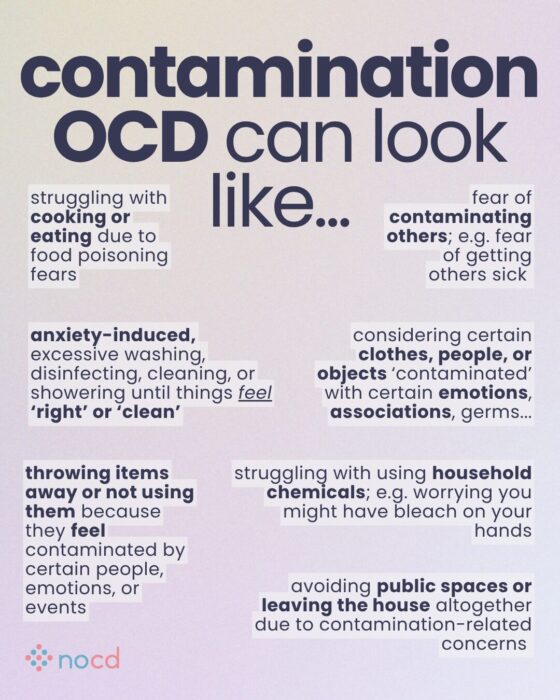
Here are some examples of how Contamination OCD can show up:
Over time, these compulsions can take up more and more space in a person’s life. Someone may spend hours washing, cleaning, avoiding certain places, throwing away food, or asking loved ones for reassurance. Because compulsions only relieve distress temporarily, contamination fears often come back feeling even more urgent.
How is Contamination OCD diagnosed?
Contamination OCD isn’t a separate diagnosis in the Diagnostic and Statistical Manual of Mental Disorders (DSM-5-TR). Instead, it’s a recognized presentation of OCD, with obsessions and compulsions centered on contamination.
A licensed mental health professional can evaluate whether your symptoms meet the criteria for OCD by asking what thoughts come up, how you respond to them, and how much they interfere with your life.

Find the right OCD therapist for you
All our therapists are licensed and trained in exposure and response prevention therapy (ERP), the gold standard treatment for OCD.
How is Contamination OCD treated?
You can’t eliminate every germ, illness, chemical, or source of contamination from your life. Trying to do so—through washing, cleaning, checking, avoidance, or reassurance-seeking—usually makes Contamination OCD stronger over time. That’s why treatment doesn’t focus on proving that something is completely clean or safe. It focuses on changing how you respond when uncertainty shows up.
The most effective treatment for Contamination OCD–and OCD in general–is exposure and response prevention (ERP) therapy. ERP is a specialized form of cognitive behavioral therapy (CBT) that teaches you to gradually face intrusive thoughts and triggers without performing compulsions.
For someone with Contamination OCD, ERP might look like:
- Touching a surface that feels contaminated without washing your hands right away.
- Preparing food without repeatedly checking, cleaning, or starting over.
- Walking through grass that might have been treated with pesticides without inspecting your shoes or the floor afterward.
- Spending time with someone who triggers feelings of emotional contamination without seeking reassurance that you’re still a good person.
- Sitting with the thought, “Maybe I could get sick, or maybe I could get someone else sick,” without trying to find certainty.
Over time, ERP helps you learn that intrusive fears, sensations, and feelings of contamination don’t have to control your behavior. The goal isn’t to stop caring about health or safety. It’s to build confidence that you can tolerate uncertainty without organizing your life around compulsions.
Studies show that ERP therapy is highly effective, with 80% of people with OCD experiencing a significant reduction in their symptoms.
ERP is sometimes combined with other approaches, including:
- Medication, particularly selective serotonin reuptake inhibitors (SSRIs)
- Mindfulness-based strategies
- Acceptance and commitment therapy (ACT)
Severe or treatment-resistant OCD may sometimes require higher levels of care, such as intensive outpatient programs (IOPs), partial hospitalization programs (PHPs), residential treatment, or other specialized interventions like transcranial magnetic stimulation (TMS).
Bottom line
Contamination OCD can make ordinary exposures in day-to-day life feel like emergencies. What if you get sick? What if you spread germs? What if one contaminated thing contaminates everything else?
But not every risk can be eliminated. You don’t have to wash, clean, check, avoid, or seek reassurance every time OCD says something might be unsafe.
With ERP therapy, you can learn to face contamination fears without treating them like emergencies you have to solve right away. The goal isn’t to stop caring about health, cleanliness, or other people’s safety. It’s to stop letting OCD organize your life around impossible certainty.